


Quick answer: To use a Nepali birth certificate abroad, you generally need a certified translation (Nepali → English) produced by a licensed notary public under section 4 of the Notary Public Act 2063. Where the receiving authority, visa category, or destination embassy asks for further authentication, the notarised translation is taken by the applicant to the Ministry of Foreign Affairs (MoFA) Consular Service Department, Tripureshwor, Kathmandu for consular attestation, and then to the destination country’s embassy for final legalisation. Notary Nepal provides the translation and notarisation step; the MoFA and embassy steps are arranged separately by the applicant. Contact us for a quote based on your document.
1. Why a Birth Certificate Needs Translation
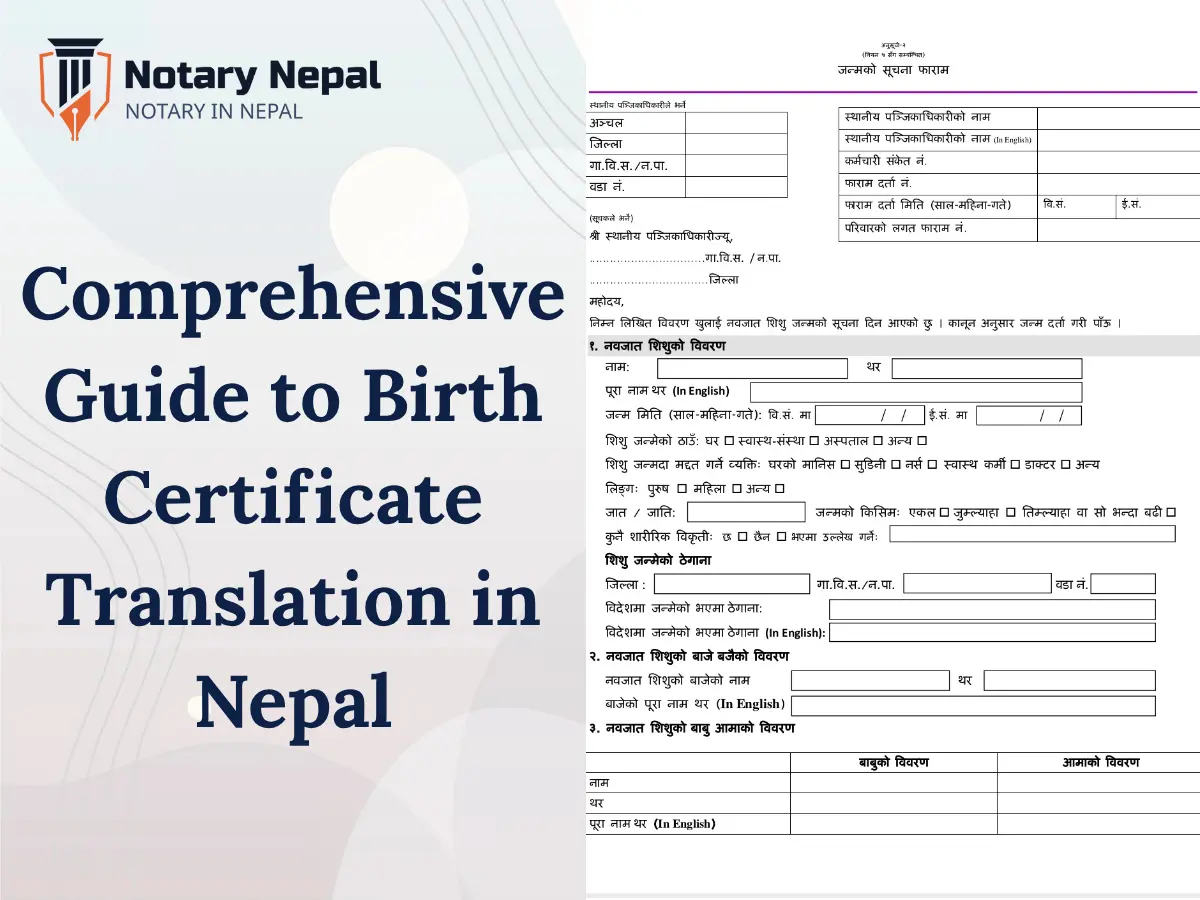
A Nepali birth certificate (janma darta praman patra) is issued in the Nepali (Devanagari) script by the Local Level Registrar under the Births, Deaths and Other Personal Events (Registration) Act 2033 (1976) and the Local Government Operation Act 2074 (2017). Since almost no foreign authority reads Nepali, a certified English translation is the default requirement for:
- Visa and immigration applications — US DS-260, UK spouse / dependent visa, Schengen long-stay, Australia subclass 309/820/186, Canada PR / PGWP.
- Study abroad — university admission, scholarship, I-20, CAS, confirmation of enrolment.
- Foreign citizenship or naturalisation — age and parentage proof.
- Overseas marriage registration — affidavit of single status plus birth proof.
- Employment and work permits — Gulf, Japan SSW, Korea EPS, Malaysia.
- Dual-country pension, inheritance, and legal proceedings.
2. Legal Basis for Certified Translation in Nepal
The translation and certification of a Nepali birth certificate for foreign use rests on four instruments:
| Statute / Rule | Relevance |
|---|---|
| Notary Public Act 2063 — Section 4(c) | Empowers a licensed notary to translate a document between Nepali and English (or other prescribed language) and certify the translation with signature, stamp, and register entry. |
| Notary Public Rules 2063 — Rule 23 | Caps the maximum fee a notary may charge for translation and certification (commonly NPR 500–1,500 per page). |
| Births, Deaths and Other Personal Events (Registration) Act 2033 | Governs the issuance and format of the original birth certificate by the Local Level Registrar. |
| Local Government Operation Act 2074 | Vests the Ward Office of each municipality and rural municipality with the registrar function for births and related personal events. |
Note on apostille: Nepal is not a party to the Hague Apostille Convention, so MoFA does not issue apostilles. Where authentication beyond the notary is needed, the Nepali chain is MoFA consular attestation followed by destination-country embassy legalisation.
Translations done by a private translation agency are not accepted by most embassies unless they are subsequently notarised by a licensed notary public — the notary’s signature and seal are what create the legal presumption of accuracy.
3. The Full Authentication Chain (Step-by-Step)
Step 1 — Obtain the Original Birth Certificate
Apply at the Local Level Registrar (Ward Office of the Municipality or Rural Municipality where the birth was registered). Required documents:
- Application form (available free at the ward).
- Parents’ citizenship certificate copies.
- Hospital discharge summary or birth proof (for fresh registration).
- Citizenship of the applicant (if adult).
Fee: NPR 0 for fresh registration within 35 days of birth; NPR 50–100 for delayed registration or a duplicate copy.
Step 2 — Certified Translation (Nepali → English)
A licensed notary public produces a bilingual or English-only translation on his or her letterhead, matching the original line-for-line. The translation is then stamped, signed, dated in both Bikram Sambat and AD calendars, and recorded in the notary register under Rule 17. The format typically includes:
- Heading: “Certified True Translation from Nepali to English”.
- Full translation of every field — name, date of birth, place of birth, parents’ names, citizenship numbers, registration number and date, issuing office.
- Notary certification clause: “I certify that the above is a true and accurate translation of the original Nepali document.”
- Notary signature, seal, licence number, and district.
Step 3 — Verification at District Court or Ministry of Law (where required)
For certain destinations, MoFA requires prior verification of the notary’s signature by the District Court or the Ministry of Law, Justice and Parliamentary Affairs. This step is commonly waived when the notary’s specimen is already on file with MoFA.
Step 4 — MoFA Consular Attestation (when required)
Where the destination authority or embassy asks for a higher-level stamp beyond the notary, the notarised translation goes to the Consular Service Department, Ministry of Foreign Affairs, Tripureshwor, Kathmandu. MoFA verifies the notary’s signature against its specimen database and affixes its attestation stamp. Fee is modest (around NPR 500–800) with 1–2 working-day turnaround. Nepal is not a Hague Apostille member, so MoFA issues consular attestation, not apostille.
Step 5 — Destination Embassy Legalisation
After MoFA attestation, take the document to the destination country’s embassy or consulate in Kathmandu or New Delhi for the final legalisation stamp. Embassy fees vary (typically USD 20–50). Some Gulf and Asian embassies additionally require attestation by the destination country’s own Ministry of Foreign Affairs on arrival.
4. Do I Actually Need MoFA and Embassy Steps?
Not every use requires the full chain. Use this quick guide:
| Purpose / Destination | Typical Authentication Needed |
|---|---|
| Domestic use in Nepal (bank, school, ward) | Notary-certified translation only |
| Student visa to the US, UK, Canada, Australia, Schengen | Notary + MoFA attestation (and, where demanded, destination embassy stamp) |
| Spouse / dependent / immigration visa (most countries) | Notary + MoFA attestation + destination embassy legalisation |
| Employment / work visa to Gulf, Malaysia, China | Notary + MoFA attestation + destination embassy legalisation |
| Overseas marriage, inheritance, court proceedings | Notary + MoFA attestation + destination embassy legalisation |
Always reconfirm with the destination embassy or university before submission — requirements change and some institutions (for example certain US universities) accept a notarised translation on its own.
5. Fees, Timelines and What You Pay For
| Service | Typical Fee (NPR) | Time |
|---|---|---|
| Fresh / duplicate birth certificate (Ward Office) | 0 – 100 | Same day |
| Certified translation by notary public (per page) | 500 – 1,500 | Same day / next day |
| Notary attestation of translation | 200 – 500 | Same day |
| MoFA consular attestation (where required) | 500 – 800 | 1–2 working days |
| Destination embassy legalisation | Embassy-specific (USD 20–50) | 1–5 working days |
| Typical translation + notary package | 1,000 – 2,500 | Same day / next day |
| Full chain (translation + notary + MoFA + embassy) | 2,500 – 6,000 + embassy fee | 3–7 working days |
6. English to Nepali Translation — The Reverse Direction
When a foreign-born child of Nepali parents needs a Nepali citizenship or passport, the foreign birth certificate must be translated from English (or the local language) into Nepali and notarised. The same Section 4(c) framework applies: a licensed Nepali notary public produces the translation, certifies it, and the Local Level Registrar relies on it to issue a Nepali birth record. If the foreign original is not in English, a two-stage translation (foreign language → English by a sworn translator abroad, authenticated in that country, then English → Nepali by a Nepali notary) is usually required.
7. Common Reasons Translations Get Rejected
- Name spelling mismatch between passport and translated certificate — always match passport spelling exactly.
- Incomplete translation — every stamp, seal, and margin note on the original must be translated or described (“[round seal of Kathmandu Metropolitan City]”).
- Missing notary register entry — embassies sometimes ask for the register serial number.
- Expired translation — US, UK and Schengen missions often require the translation to be dated within the last 6 months.
- Wrong notary district — the notary must be licensed in the district where the act is performed.
- Authentication applied to the translation but not the underlying copy — some destinations want both stamped.
- Photocopy vs original — MoFA attestation is applied only to a properly notarised document set, not to loose photocopies.
8. Document Checklist Before Walking into MoFA
- Original Nepali birth certificate (recent issue where the destination demands it).
- Certified English translation on notary letterhead, stapled to a copy of the original.
- Applicant’s citizenship or passport copy.
- Authorisation letter (if submitted through a representative) plus representative’s citizenship copy.
- MoFA voucher / online token (check mofa.gov.np for the current booking system).
- MoFA fee in cash at the counter.
9. Online and Courier Options
MoFA submission and collection remain in person at Tripureshwor, Kathmandu — there is no fully online portal. Applicants outside Kathmandu can use a notarised Power of Attorney to authorise a relative, a lawyer, or a licensed documentation service to file on their behalf. Professional document services in Kathmandu commonly offer full door-to-door handling — collection, translation, notary, MoFA submission, and courier back — for an all-in service charge on top of government fees.
10. How Notary Nepal Helps
Notary Nepal (Anamnagar, Kathmandu) is a licensed Kathmandu-district notary practice. Our service scope is strictly the notarial part of the chain:
- Same-day certified Nepali ↔ English translation by a licensed notary public.
- Register-recorded notary attestation with proper stamp and dated receipt.
- Translation of supporting documents — citizenship, marriage, educational, medical — prepared as a single bundle ready for onward submission.
- Drafting and certification of affidavits and powers of attorney related to birth-record matters.
The subsequent MoFA consular attestation and destination-country embassy legalisation are not handled by Notary Nepal; the applicant or an authorised representative submits the notarised bundle directly at those counters.
Frequently Asked Questions
Need a document notarised or translated?
Notary Nepal handles document notarisation and certified Nepali–English translation — walk in at Anamnagar, Kathmandu, or do it fully online.
This article is for informational purposes only and does not constitute legal advice, advertisement, or solicitation. Notary Nepal and its team are not liable for any consequences arising from reliance on this information. For legal advice, please contact us directly.






-thumb.webp)
-thumb.webp)
-thumb.webp)
-thumb.webp)
-thumb.webp)
-thumb.webp)