

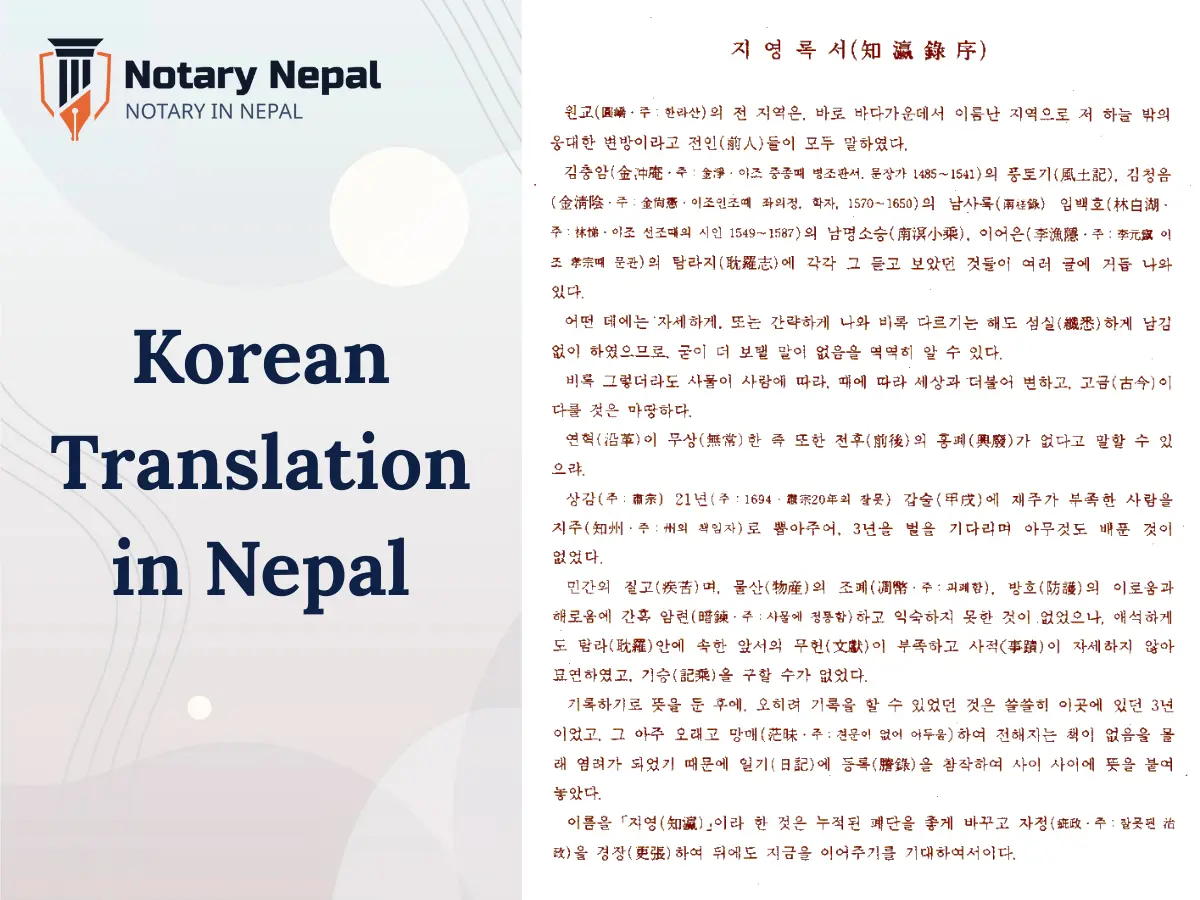

If you are a Nepali worker heading to Korea under the EPS scheme, a student applying to SNU / Yonsei / Korea University / KAIST, a spouse of a Korean national processing an F-6 marriage visa, or a Nepali company sending commercial contracts to a Seoul counterparty, your documents will almost certainly need to move between Korean, Nepali and English. This 2026 AD / 2083 BS guide explains the one workflow that is actually accepted by the Embassy of the Republic of Korea in Kathmandu, by Korean universities, by Korean immigration (출입국·외국인청), and by Korean courts — and the one workflow that is not.
The key point to get right at the beginning: a Nepali notary public's statutory translation-certification scope is Nepali ↔ English only. Korean is outside that scope. The correct workflow for Korean papers is professional translator → translator's affidavit of accuracy → notary attests the translator's signature → MoFA consular attestation → Embassy of Korea legalisation. Nepal is not in the Hague Apostille Convention, so there is no apostille short-cut.
For the steps that sit squarely within Notary Nepal's statutory competence — Nepali–English certified translation, affidavits of accuracy, and notarisation of signatures — we handle the complete pack.
Who Needs Korean Translation in Nepal?
- EPS-TOPIK candidates and EPS workers heading to Korea under the Employment Permit System (MoU since 2007)
- Students applying to Korean universities on D-2 (degree) and D-4 (language) visas — SNU, Yonsei, Korea University, KAIST, POSTECH, Hanyang, Sogang, Ewha, Sungkyunkwan, SKKU, UNIST, GIST
- Skilled worker and professional E-visa applicants (E-7 specified activity, E-9 non-professional employment)
- Marriage migrants on the F-6 visa (Nepali–Korean spouses) and their dependents
- Business applicants on D-8 (corporate investment) and D-9 (trade management)
- K-pop trainees, tour performers, and short-term cultural exchange on D-1 / C-3
- Dependents of long-term Korean residents on F-3
- Nepali returnees from Korea needing Korean documents (employment letters, pension statements, tax receipts, court papers) used in Nepal
- Nepali exporters sending contracts, invoices, test certificates and bank papers to Korean partners
- Court matters involving Korean-language evidence — marriage, inheritance, child custody, contract disputes
The Correct Two-Step Workflow for Korean Papers
Korean is outside the Nepali notary's translator-certification scope (the Nepal Notary Public Council's translator examination under Rule 7 of the Notary Public Rules 2063 covers only Nepali ↔ English). So we split the work cleanly:
- Step 1 — Professional translator produces the Korean–Nepali or Korean–English translation, line-numbers it against the source, stamps each page, and signs a translator's affidavit of accuracy (a sworn statement identifying the translator, their qualification, the source document, and a declaration that the translation is true and complete).
- Step 2 — Licensed notary attests the translator's signature on the affidavit under the Notary Public Act 2063 §§18–19 with a Rule 16 seal and Rule 17 register entry.
- Step 3 — MoFA Consular Section (at Singha Durbar) adds its consular-attestation stamp on the translator's affidavit.
- Step 4 — Embassy of the Republic of Korea in Kathmandu / Lainchaur legalises the pack before it is used in Korea.
If a Korean authority asks for a "notarised translation", what they actually receive is a translator's affidavit whose signature has been notarised — not a notary seal certifying Korean linguistic accuracy directly. This is the format Korean courts, immigration and embassies accept when papers originate in Nepal.
Parallel Nepali ↔ English Bridge Version
Most Korean authorities prefer to see an English translation alongside the Korean one, because English is the working administrative language across Korean consular, immigration and admissions offices. For citizenship, marriage, court, birth, death, academic-transcript, relationship, and migration certificates issued in Nepali, we recommend:
- Nepali → English certified translation under the Notary Public Act 2063 (Rule 16 seal applied directly) — this part is fully within Notary Nepal's statutory competence
- English → Korean (or Nepali → Korean) translation by a professional translator with affidavit of accuracy — signature notarised under the two-step workflow above
The bridge English version gives Korean reviewers a familiar administrative reading while preserving statutory authenticity at every stage.
Visa Stream Deep-Dive — Papers, Format and Stamp Chain
EPS (Employment Permit System) — E-9 Non-Professional Worker
Nepal has sent the largest cohort of EPS workers among South Asian sending countries since the 2007 MoU between Nepal's Ministry of Labour, Employment and Social Security (MoLESS) and Korea's Ministry of Employment and Labor (MOEL). The EPS route is operated through the Foreign Employment Board (FEB) and EPS Nepal (epsnepal.gov.np), with HRD Korea on the Korean side.
Typical Nepali-language papers that need translation and certification:
- Citizenship certificate (नागरिकता प्रमाणपत्र)
- Police report / character certificate from District Police
- Medical report from a HRD-Korea approved panel hospital
- Skill test certificate (EPS-TOPIK result, skill-specific test result)
- Bank statement showing contract fees
- Family papers for beneficiary / nominee declarations
The EPS-TOPIK (한국어능력시험 — EPS) result itself is issued in Korean and English by HRD Korea and does not usually need re-translation; Nepali paperwork feeding into the EPS pool does.
Student Visa — D-2 (degree) and D-4 (Korean language)
Korean universities typically request:
- Final high-school / intermediate / bachelor's transcripts and character certificates
- Migration / provisional / equivalence certificate (e.g., from CDC under Tribhuvan University, KU, PokU, MidWU, FarWU, NepU)
- Guardian's bank balance certificate and salary / income certificate
- Relationship certificate from Ward Office (Civil Registration Act 2033)
- TOPIK certificate (if already taken) — issued by National Institute for International Education (NIIED)
- Statement of purpose and study plan (often best submitted in Korean or English)
- Police clearance report (PCC) where age is 19 or above
Papers in Nepali are translated into English first under the Nepali-notary workflow, then English → Korean by a professional translator with affidavit. Transcripts from English-medium colleges often need no re-translation — only certified copy verification + notarised-signature pack.
Skilled Worker — E-7 and Technical Intern (D-10)
E-7 specified-activity visa needs a sponsor-company invitation letter, labour-market check, and proof of qualifications. Common Nepali-side papers: degree, experience letters, payslips, PCC, tax clearance. Translation stack is the same two-step flow.
Marriage — F-6
Most demanding in terms of paperwork. Korean immigration typically asks for:
- Nepali marriage registration certificate (Foreigner Marriage Act applicants: see our Foreigner Marriage translation service)
- Single-status / unmarried certificate
- Citizenship, birth, relationship, and guardian affidavits
- Health check-up and mental-health declaration
- Korean language evidence (TOPIK Level 1 minimum or KIIP programme completion) — issued by NIIED, translation usually not required
- Joint family photo album, communication history, financial history of the Korean sponsor
All Nepali papers go through: certified Nepali–English translation → translator's affidavit of Korean version → notarised signature → MoFA attestation → Embassy of Korea legalisation.
Dependent — F-3
Relationship certificate, birth certificate for children, marriage certificate, and guardian documents — same bridge-English + Korean-via-translator workflow.
Business / Investor — D-8 and D-9
Company registration, VAT / tax clearance, audited financials, board resolutions, MoA / AoA, bank balance certificates, invoices, and contracts. High-value files often benefit from a sworn translator's affidavit backed by two notary witnesses, and the Embassy may request original-sight verification at legalisation.
Documents We Handle Most Frequently
| Document | Issuing authority (Nepal) | Typical Korean end-use | Direction |
|---|---|---|---|
| Citizenship certificate | DAO / Ministry of Home Affairs | EPS, study, marriage, work visas | NE → EN → KO |
| Birth certificate | Ward Office (Civil Registration Act 2033) | Student, dependent, marriage visa | NE → EN → KO |
| Marriage certificate | Ward Office / District Court | F-6, F-3 visa | NE → EN → KO |
| Single-status / unmarried certificate | DAO / CDO office affidavit | F-6 visa | NE → EN → KO |
| Relationship certificate (नाता प्रमाण) | Ward Office | Dependent / marriage visa | NE → EN → KO |
| Academic transcripts and character certificates | School / college / CDC | University admission | NE → EN → KO (bridge) |
| Migration / provisional certificate | CDC of university | University admission | EN → KO |
| Police clearance report (PCC) | OPCR / Nepal Police | All long-term visas | NE → EN → KO |
| Medical report | HRD-Korea panel hospital | EPS, F-6, F-3 | EN → KO |
| Employment / experience letter | Employer | E-7 / D-10 | EN / NE → KO |
| Bank balance certificate | Commercial bank | Study, business, dependent | EN → KO |
| Tax clearance (PAN) | Inland Revenue Department | Business, investor | EN → KO |
| Company MoA, AoA, registration | Office of the Company Registrar | D-8 investor visa | EN → KO |
| Court papers (judgement, affidavit) | District / High Court | Evidence in Korean proceedings | NE → EN → KO |
| Power of attorney | Notary Nepal / DAO | Sale, banking, court representation in Korea | NE/EN → KO |
| Korean-issued papers for use in Nepal | Korean authority | Marriage / inheritance / tax matters in Nepal | KO → EN / NE |
The Legalisation Chain — Step by Step
| Stage | What happens | Where | Typical working days |
|---|---|---|---|
| 1a | Professional translator produces Korean version, line-numbers and seals pages, signs translator's affidavit of accuracy | Notary Nepal office / translator's premises | Same day to 2 days depending on volume |
| 1b | Licensed notary attests the translator's signature on the affidavit (Notary Public Act 2063 §§18–19, Rule 16 seal, Rule 17 register entry) | Notary Nepal | Same day |
| 2 | Line-ministry pre-attestation (academic → MoEST; judicial → Ministry of Law, Justice and Parliamentary Affairs; civil-registration → Department of Civil Registration) | Singha Durbar | 1–3 days |
| 3 | Ministry of Foreign Affairs (MoFA) Consular Section attestation — Nepal is not in the Hague Apostille Convention, so the correct terminology is MoFA consular attestation, not "apostille" | MoFA, Singha Durbar | 1–2 days |
| 4 | Embassy of the Republic of Korea, Kathmandu — legalisation / attestation counter | Red Cross Marg, Lainchaur | 1–3 days |
Total working-day window: typically 5 to 10 working days for a clean pack. Peak seasons (March intake, September intake, EPS sign-up windows, Chuseok / Korean New Year holidays) add 3–5 days. Notary Nepal handles Stages 1a and 1b; Stages 2, 3 and 4 are government and embassy counters the applicant coordinates directly or through a recognised agent.
What a Proper Translator's Affidavit Looks Like
A well-drafted translator's affidavit for a Korean translation should contain, at minimum:
- Translator's full name, citizenship number / passport number, qualification (degree, TOPIK or KIIP certification), and address
- Clear identification of the source document (title, issuing authority, date, reference number, page count)
- Direction of translation (Nepali → Korean, English → Korean, Korean → English, Korean → Nepali)
- A sworn declaration that the translation is a true, complete, and accurate rendering of the source
- Translator's signature (wet-ink) on the affidavit, and translator's stamp / initial on every page of the translation
- Date and place of signing
- Notary's attestation block: "Signed before me by the translator identified above. I attest only the identity and signature of the translator. The linguistic accuracy of the Korean text is the translator's professional responsibility." — with Rule 16 seal and Rule 17 register number
Embassies and immigration offices frequently reject packs where the notary seal appears directly on the Korean translation as if the notary were certifying the Korean content itself — that formulation is outside the notary's statutory competence.
Common Pitfalls That Cause Rejection
- Using the word "apostille" on documents for Korea — Nepal is not in the Hague Apostille Convention; the correct phrase is MoFA consular attestation
- Notary seal placed on a Korean translation as if it certifies the Korean text (outside notary's scope)
- Translator's affidavit missing citizenship / passport number of the translator
- Different dates on affidavit, notary attestation, and MoFA stamp creating a visible inconsistency
- Typos in Romanised names that do not match passport spelling
- Using a scanned signature instead of wet-ink signature
- Missing stapling / seal bridging pages — Korean reviewers like a clean paginated set with one page-count statement on the cover
- Omitting the Nepali original — always submit original + certified copy + translation + affidavit as one bundle
- Applying for legalisation at the Embassy of Korea without first going through MoFA Consular Section
Korean-Issued Papers Used in Nepal
Nepali workers returning from Korea, marriage migrants settling in Nepal, and researchers with Korean awards often bring back:
- Employment certificate / 경력증명서
- Pension statement from NPS Korea
- Tax payment receipts / 원천징수영수증
- Korean court judgements (custody, divorce, inheritance)
- Academic diplomas / 학위증명서
- Medical discharge summaries
- Registration of residence / 주민등록등본 (for children born in Korea)
These Korean originals first go through: notarisation in Korea → apostille from the Korean Ministry of Foreign Affairs (Korea is in the Hague Convention) → Embassy of Nepal in Seoul attestation → onward use in Nepal with a Korean → English → Nepali translation pack where a Nepali notary attests the translator's signature on the English / Nepali affidavit.
EPS-TOPIK — Where Translation Fits
The EPS-TOPIK test itself is a Korean-language test conducted in Nepal by HRD Korea through EPS Nepal. The pass certificate is issued in Korean and English. What typically needs translation is the supporting Nepali paperwork a candidate submits for job-roster selection and for the final employment contract in Korea — not the test result. Workers should keep both the Nepali originals and the English certified copies indexed, because HRD Korea and individual Korean employers occasionally ask for re-verification after arrival.
Time, Cost and Legal Responsibility
Time: a standard 1–2 page document can be fully packed (translator + notary) in 1–2 working days; a study pack with transcripts + financial + police papers typically takes 3–5 working days before entering MoFA and Embassy stages.
Cost: Notary Nepal does not publish its service-fee schedule in articles; government-side fees (MoFA consular stamp, Embassy legalisation fee, court attestation) are the applicant's responsibility and are posted at the relevant counters. The statutory notary fee ceiling for attestations under the Notary Public Act 2063 Rules is modest.
Legal responsibility: the translator bears professional responsibility for the linguistic accuracy of the Korean text (that is what the affidavit commits to); the notary's liability is limited to the verification of the translator's identity and signature at the time of attestation, plus a Rule 17 register entry retained for 15 years.
When You Can — and Cannot — Use a Notary Seal Directly
You can apply a Rule 16 notary seal directly on:
- A Nepali → English certified translation (both languages are within the notary's statutory translator scope)
- A Nepali or English affidavit
- A power of attorney drafted in Nepali or English
- Certified copies of Nepali / English source documents
You cannot apply a notary seal directly claiming to certify:
- The linguistic accuracy of a Korean translation (the Council's translator exam does not include Korean)
- A Korean-language affidavit as if the notary were sworn to interpret it
- A standalone Korean-only declaration where the signatory is not present before the notary
For Korean, the correct instrument is always: translator's affidavit → notarised signature.
Why Notary Nepal
- Statutory clarity — we operate strictly within the Notary Public Act 2063 and work with professional Korean translators whose affidavits have been accepted at MoFA and Embassy of Korea repeatedly
- Bridge English pack — we certify the Nepali → English version in-house under the notary's direct translator scope, saving a step
- Format checklist — every pack leaves our office with a page-count certificate, stapling, bridging seal, and translator's affidavit in the exact format Korean reviewers expect
- Follow-up support — if MoFA or the Embassy raises a query, we re-sign and re-attest quickly so your intake deadline does not slip
- No apostille confusion — our paperwork correctly labels the government stamp as "MoFA consular attestation" and the embassy step as "legalisation", preventing rejections caused by mislabelling
Related Services and Reading
- Certified document translation (Nepali ↔ English)
- Multilingual document translation and verification
- Affidavits and sworn statements
- Document notarisation
- Foreigner Marriage Act translation
- Power of attorney in Nepal
- Japanese translation services in Nepal
- Alternative to apostille — MoFA attestation chain
Final Word
Korean paperwork from Nepal works reliably when you use the right instrument at each step: a professional translator produces the Korean text and signs an affidavit; a licensed notary attests that signature; MoFA consular attestation follows; and the Embassy of the Republic of Korea legalises the final pack. Skip a step or misuse an apostille label, and the pack will come back. Get it right once and your EPS, study, work, marriage or business file moves on schedule. For the parts that are squarely within the notary's statutory competence, Notary Nepal is ready to help.
Frequently Asked Questions
Need a document notarised or translated?
Notary Nepal handles document notarisation and certified Nepali–English translation — walk in at Anamnagar, Kathmandu, or do it fully online.
This article is for informational purposes only and does not constitute legal advice, advertisement, or solicitation. Notary Nepal and its team are not liable for any consequences arising from reliance on this information. For legal advice, please contact us directly.





-thumb.webp)
-thumb.webp)
-thumb.webp)
-thumb.webp)
-thumb.webp)
-thumb.webp)