


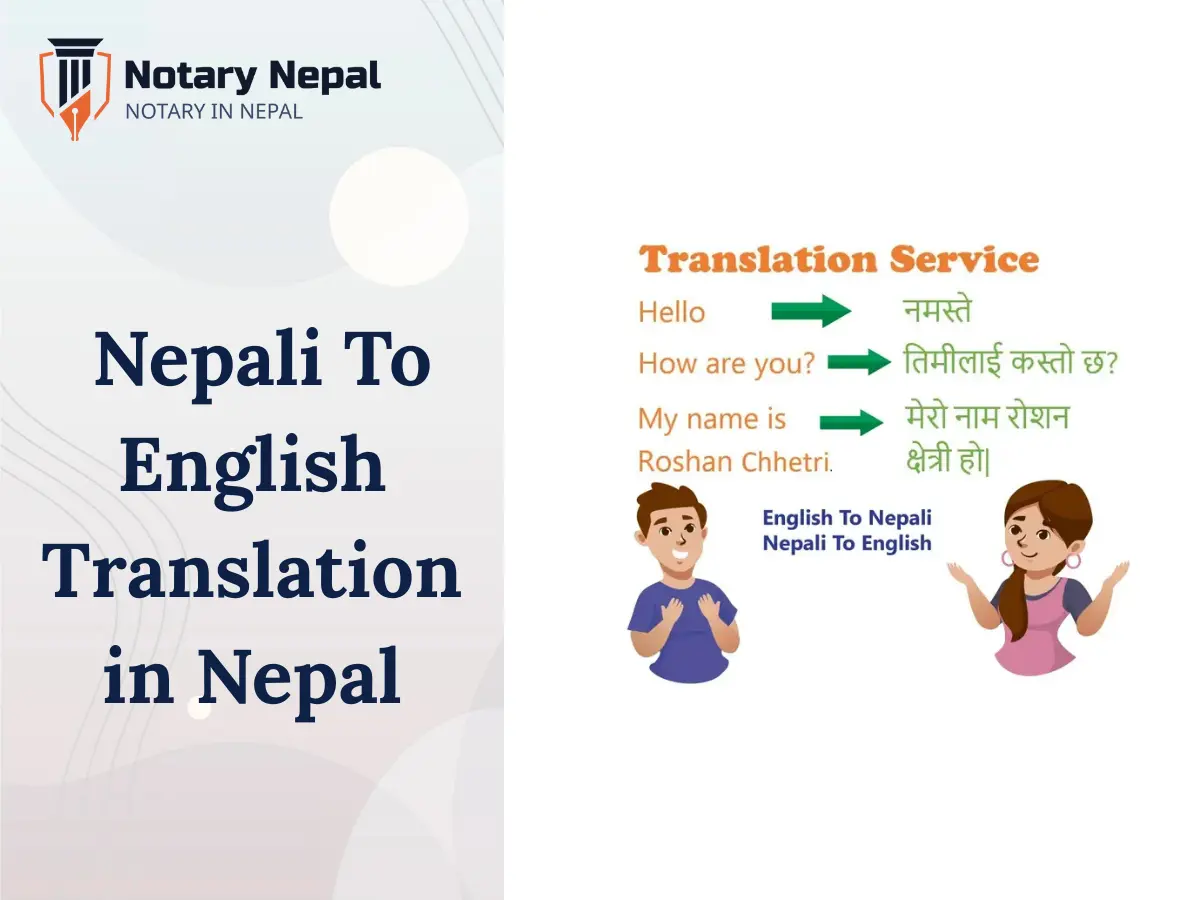

Every embassy application, foreign university admission, overseas job placement, and international court filing that originates in Nepal eventually runs into the same requirement: the Nepali document must be translated into English and the translation must be certified. Whether it is a citizenship card going to the Canadian visa office, a birth certificate needed for the US DS-160 form, academic transcripts headed for an Australian university, or a marriage registration asked for by Nepali missions abroad — an unofficial Google Translate output will not be accepted. This guide explains, in plain terms, how Nepali to English translation in Nepal actually works in 2026 (FY 2082/83): the law behind it, the documents most often translated, realistic costs, turnaround times, and exactly what "notarised" and "certified" mean on the final stamped page.
Quick Answer — Nepali to English Translation in Nepal: A valid certified translation in Nepal is prepared by a qualified translator, printed on letterhead with the translator's signature and stamp, and then notarised under the Notary Public Act, 2063 by a Nepal Notary Council–licensed notary. For visa, MoFA apostille, or embassy submission, the notarised translation is further authenticated by the Ministry of Law, Justice and Parliamentary Affairs (for foreign use) or the Ministry of Foreign Affairs (mofa.gov.np). Typical cost in Kathmandu is NPR 500–1,500 per page with 24-hour delivery for standard documents.
Legal Basis: Who Can Certify a Nepali to English Translation in Nepal
Certified translation in Nepal is not regulated by a separate "sworn translator" licensing body the way it is in Germany or Spain. Instead, the legal weight of a translated document comes from notarisation — the notary public attests that the translator appeared before them, identified themselves, and declared on oath that the translation is a true and faithful rendering of the original. The controlling statute is the Notary Public Act, 2063 (2006), with the Notary Public Rules, 2063 spelling out the procedure. Both are published in full on the Nepal Law Commission portal and administered by the Nepal Notary Council.
Section 4 of the Act lists the functions a notary public may perform, which includes attesting the translation of any document from one language to another. Rule 27 of the Notary Public Rules then requires the notary to note, in the attestation, (i) the identity of the translator, (ii) the declaration that the translation is accurate, and (iii) the notary's own registration number and seal. In practice, this is the stamp, signature and serialised number you see on every page of a notarised translation in Nepal.
| Role | What They Do | Legal Authority |
|---|---|---|
| Translator | Produces the English text, signs and stamps each page as translator of record | Professional qualification (BA/MA in English, legal or language background) |
| Notary Public | Administers the translator's oath and attests the translation | Notary Public Act 2063, §4 & Rule 27 |
| Ministry of Law (for Hague apostille) | Apostille stamp for Hague Convention countries | Nepal acceded to Hague Apostille Convention 2023 (effective 2024) |
| Ministry of Foreign Affairs (MoFA) | Authentication / legalization for non-Hague countries | Department of Consular Services, MoFA |
| Destination embassy | Final legalization stamp where required (e.g. UAE, China, Saudi Arabia) | Bilateral consular practice |
Most-Translated Nepali Documents into English (2026)
Search demand on Google makes this very clear — the bulk of Nepali to English translation work in Kathmandu is on a fairly narrow set of personal and educational records. Based on actual queries, the top document types are:
1. Nepali Citizenship Card (Nagarikta) Translation
The citizenship card issued under the Nepal Citizenship Act, 2063 is the single most-translated document in Nepal. It is required for visa applications (Canada, USA, Australia, Schengen), NRN registration, foreign property purchases, and overseas work permits. A standard citizenship translation in English format will mirror the bilingual fields of the original card: citizenship number, issue district, full name, date of birth (AD and BS), father's and mother's name, permanent address, and the issuing authority's details. The translator then certifies the translation and a notary attests it.
2. Birth Certificate Translation (Janma Darta Pramanpatra)
Birth certificates are issued by the local ward office under the Birth, Death and Other Personal Events (Registration) Act, 2033 and are overwhelmingly in Devanagari. English translation is essential for IRCC study permits, US visitor visas, UK Home Office settlement applications, and Australian dependent visas. The translation must reproduce the registration number, ward, municipality/rural municipality, district, parents' names, date of birth (AD), place of birth, and registration date.
3. Academic Transcripts, Character Certificates and Marksheets
SEE, +2 (NEB), Bachelor's and Master's transcripts are required by essentially every foreign university and credential evaluator (WES, IQAS, ECE, NARIC). While Tribhuvan University, Kathmandu University and most Nepali universities already issue English transcripts, SEE marksheets, NEB grade sheets issued in Nepali, and older private school mark sheets typically need translation. Character certificates from schools and colleges are also commonly translated and notarised.
4. Marriage Certificate Translation
Issued under the Marriage Registration Act, 2028 by the local registrar, Nepali marriage certificates need English translation for spouse visas, dependent visas, name-change updates overseas, and joint property filings. Court marriage certificates require the same process.
5. Property, Land Ownership (Lalpurja) and Relationship Documents
Lalpurja (land ownership certificate) — required when property is offered as financial sponsorship or collateral for foreign visa applications.
Relationship certificate (Nata Pramanit) — issued by the ward office; needed for family visas and NRN dependent applications.
Migration certificate (Basai-sarai) — for changes of permanent residence.
Death certificate (Mrityu Darta) — for inheritance, insurance and pension claims abroad.
6. Legal, Business and Court Documents
These include court judgments, FIR copies, police reports, affidavits, powers of attorney, company PAN/VAT certificates, OCR-issued company registration, audit reports, shareholder agreements, and board resolutions. When translated for use abroad, they typically move onwards to MoFA authentication.
Step-by-Step: How to Translate a Nepali Document to English
Submit the original document — scanned PDF or clear phone photo is accepted for the first draft; the hard copy (or notarised photocopy of it) is needed for the final attestation.
Receive a quote — priced per page (not per word), based on density of Nepali text, tables, seals and urgency.
Translation & proofreading — the translator renders the text into English, formats it to resemble the original layout, and a second pair of eyes proofreads for legal accuracy.
Translator's declaration — the translated pages are printed on letterhead; the translator signs and stamps each page.
Notarisation — a licensed notary under the Notary Public Act 2063 attests the translation (this is the stamp that makes it legally usable).
MoFA / apostille (if required) — for use outside Nepal, documents are authenticated by MoFA (legalization) or stamped with a Hague apostille through the Ministry of Law.
Delivery — digital (PDF) and hard copy; express 24-hour service available for standard one-page documents.
Common mistake: submitting a translation notarised outside Nepal (for example a US notary's stamp on a Nepali citizenship translation) to the Nepali MoFA for apostille. MoFA only apostilles documents notarised within Nepal by a Nepal Notary Council licensed notary. If the translation was done abroad, it needs to be re-notarised in Nepal or legalised by the Nepali embassy in that country first.
Cost of Nepali to English Translation in Nepal (2026)
Pricing in Kathmandu is remarkably stable and is charged per page, not per word. Below is the typical market rate as of 2026:
| Document Type | Translation Cost | Notary Fee | Total (typical) |
|---|---|---|---|
| Citizenship card (single page) | NPR 400–700 | NPR 100–200 | NPR 500–900 |
| Birth / death / marriage certificate | NPR 500–900 | NPR 100–200 | NPR 600–1,100 |
| SEE / NEB / University marksheet (per semester) | NPR 600–1,200 | NPR 100–200 | NPR 700–1,400 |
| Character certificate | NPR 500–800 | NPR 100–200 | NPR 600–1,000 |
| Lalpurja / land ownership certificate | NPR 800–1,500 | NPR 200–300 | NPR 1,000–1,800 |
| Affidavit / Power of Attorney | NPR 1,000–2,500 | NPR 200–500 | NPR 1,200–3,000 |
| Court judgment / legal brief (per page) | NPR 1,500–3,000 | NPR 200–300 | NPR 1,700–3,300 |
| Express same-day / 24-hr surcharge | +50–100% | — | Negotiable |
Add MoFA authentication fee of NPR 200 per document (standard) or NPR 500 for same-day service if the translation needs to go abroad. Apostille fees at the Ministry of Law follow the same schedule.
Turnaround Times
| Service | Standard | Express |
|---|---|---|
| Single-page document (citizenship, birth, marriage) | Same day – 1 working day | 2–4 hours |
| Transcripts / marksheets (multi-page) | 1–2 working days | Same day |
| Legal / court / corporate documents | 2–3 working days | 1 working day |
| MoFA authentication after notarisation | 1 working day | Same day (limited window) |
Embassy & Visa Acceptance of Nepali-to-English Translations
A notarised Nepali-to-English translation is accepted by effectively every major visa authority, provided the original and translation are submitted together. Typical requirements:
IRCC (Canada) — certified translation by a qualified translator plus an affidavit or a notary's attestation.
USCIS / US embassies — translator's certification of accuracy and competence; notarisation not mandatory but commonly expected for Nepal-origin documents.
UK Home Office — certified translation with translator's credentials, date, contact details and statement of accuracy.
Australian Department of Home Affairs — NAATI-certified where available; outside Australia, an approved translator's certification is accepted.
Schengen embassies (Germany, France, Italy, Spain) — notarised translation + apostille (Hague Convention, effective for Nepal since 2024).
UAE, Saudi Arabia, Qatar, Kuwait — notarised translation + MoFA authentication + destination embassy attestation in Kathmandu.
Apostille vs Legalization: Which One Does Your Translation Need?
Nepal acceded to the Hague Apostille Convention in 2023 (effective 2024), which simplified the chain for documents going to any of the 120+ member countries. Broadly:
Apostille route — destination is a Hague member (UK, USA, Australia, EU, Japan, South Korea, India, etc.). Path: translator → notary → Ministry of Law apostille. No further embassy stamping is needed.
Legalization route — destination is a non-Hague country (UAE, Saudi Arabia, China, Kuwait, Qatar). Path: translator → notary → MoFA authentication → destination embassy attestation.
For a detailed walkthrough, see our guides on apostille of documents in Nepal and legalization of documents in Nepal.
Translation Services in Kathmandu and Other Cities
Our head office in Anamnagar, Kathmandu handles the bulk of Nepali-to-English translation work, but we also operate through partner notaries across Nepal. Regional guides:
Why a Google-Translate Output Will Not Be Accepted
Visa officers, universities and courts reject machine translations for three reasons:
No certifying authority — there is no identifiable translator who takes responsibility for accuracy.
Legal terminology errors — "नागरिकता" rendered as "nationality" instead of "citizenship", "वडा" rendered as "ward number" without the proper administrative unit, and many similar errors routinely appear in machine output.
Document layout is lost — a certified translation must visibly correspond to the original; MT output does not preserve seals, signatures, serial numbers and registrar fields in positionally correct form.
What a Properly Certified Translation Looks Like
A valid notarised translation produced in Nepal has every one of the following on the final page:
The full English text, formatted to mirror the original (header, body, tables, seals indicated in brackets).
Translator's certification statement — "I, [name], certify that I am competent in Nepali and English and that the foregoing is a true and accurate translation of the attached original Nepali document."
Translator's signature, printed name, date and contact details.
Notary's stamp and signature bearing the notary's registration number under the Notary Public Act 2063.
Attached original (or notarised copy) physically bound to the translation so pages cannot be substituted.
Related Services
Contact Us
Notary Nepal — Anamnagar, Kathmandu. Phone +977-9765979296. Email info@notarynepal.com. For an instant quote, send a scanned copy of your document and tell us the destination country.
Frequently Asked Questions
Need a document notarised or translated?
Notary Nepal handles document notarisation and certified Nepali–English translation — walk in at Anamnagar, Kathmandu, or do it fully online.
This article is for informational purposes only and does not constitute legal advice, advertisement, or solicitation. Notary Nepal and its team are not liable for any consequences arising from reliance on this information. For legal advice, please contact us directly.





-thumb.webp)
-thumb.webp)
-thumb.webp)
-thumb.webp)
-thumb.webp)
-thumb.webp)